


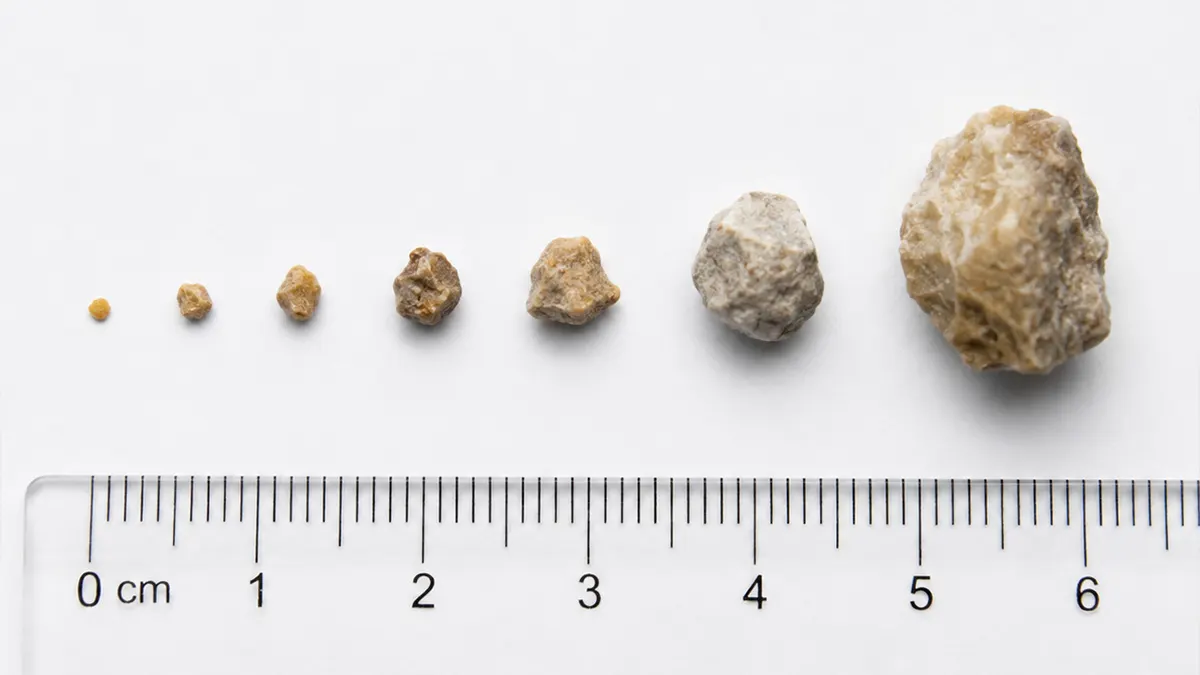
Stones under 5 mm usually pass on their own with fluids and pain relief. Between 5 and 10 mm the chance drops and medication may help. Above 10 mm a stone rarely passes and usually needs a procedure. Above 20 mm, keyhole surgery through the back is the usual choice.
Quick Navigation
With kidney stones, the number on your scan report genuinely matters. Size is the single strongest predictor of whether a stone will pass on its own, and it maps onto the treatment pathway more directly than almost any other measurement in medicine.
That is not true of every stone. Gallstone size works completely differently, because the gallbladder is a storage sac rather than a drainage tube. Here, the stone has to travel, and how wide it is decides whether it can.
Why Size Matters Here
A kidney stone has to pass down the ureter, the narrow tube connecting each kidney to the bladder. The ureter is only a few millimetres wide and can stretch a little, but not much.
So the question is mechanical. If the stone is narrower than the passage it needs to travel through, it will usually make the journey given time, fluids and pain relief. If it is wider, it will get stuck, and a stuck stone causes blockage, infection and pressure damage to the kidney.
The Size Thresholds
Stones are measured in millimetres, usually on a low-dose CT scan.
- Under 5 mm. Most pass on their own, often within a few weeks. Treatment is usually hydration, pain relief and watchful waiting.
- 5 mm to 10 mm. The middle band. Many still pass, and medication that relaxes the ureter can improve the odds. Some need a procedure if they stall or cause ongoing problems.
- Above 10 mm. Passage becomes unlikely. A procedure is usually needed to prevent blockage, infection or kidney damage.
- Above 20 mm. Almost always requires keyhole surgery through a small incision in the back, which is the most effective approach for large or complex stones.
Even a small stone can need intervention if it causes severe pain, a fever or a complete blockage, so these bands describe likelihood rather than certainty.
Size and Likely Treatment
| Stone Size | Likely Approach | What to Expect |
|---|---|---|
| Less than 5 mm | Hydration, pain relief and monitoring | High chance of passing naturally, often within weeks |
| 5 mm to 10 mm | Medication to relax the ureter, or lithotripsy or ureteroscopy | Depends on location and how it responds over the first few weeks |
| Greater than 10 mm | Ureteroscopy, RIRS or percutaneous surgery | Rarely passes alone, a procedure is usually the first-line plan |
| Over 20 mm | Percutaneous nephrolithotomy | The most effective option for very large or staghorn stones |
What Else Decides It
Size sets the expectation. Several other factors shift it.
- Location. A stone already low in the ureter, close to the bladder, has a better chance of passing than one of the same size still sitting in the kidney.
- Your symptoms. Severe pain, fever, nausea or visible blood prompt faster action regardless of measurement.
- Stone composition. Some types are harder and resist being broken up by sound waves. Uric acid stones, by contrast, can sometimes be dissolved with medication and diet.
- Your kidney health. Having a single kidney, an existing infection, reduced kidney function or being pregnant all lower the threshold for intervention.
- Total stone burden. Several small stones together can warrant the same approach as one larger stone.
If you are not yet sure whether what you are feeling is a stone, how kidney stone symptoms differ from a UTI or period pain covers the distinguishing features, and kidney pain versus back pain covers the other common confusion.
The Procedures Explained
All of the options below are far less invasive than open surgery, which is now rarely needed.
- Shock wave lithotripsy. Sound waves delivered from outside the body break the stone into fragments small enough to pass. No incision at all. Best suited to smaller stones in certain positions. More detail on lithotripsy at Unittas.
- Ureteroscopy and RIRS. A very thin scope passes up through the urinary tract to reach the stone, which is then removed or broken up with a laser. No external incision. Suited to many ureteric and smaller kidney stones. See RIRS for kidney stones.
- Percutaneous nephrolithotomy. Keyhole surgery through a small incision in the back, giving direct access to the kidney. The standard choice for large or staghorn stones. See PCNL surgery.
- Medical expulsive therapy. Not a procedure at all. Medication that relaxes the ureter to help a borderline stone pass, usually tried first in the 5 mm to 10 mm band.
When Surgery Becomes Necessary
Beyond size alone, intervention is usually recommended when:
- The stone is too large to pass and pain is ongoing
- There is a blockage that is affecting kidney function
- An infection develops behind the blockage, which is urgent
- Conservative management has been tried for a reasonable period without progress
Do Not Wait On These
Fever or chills alongside stone pain can mean an infected, obstructed kidney. That combination needs treatment within hours, not days, whatever the stone measures. The same applies if you are passing little or no urine.
For stones that are being watched rather than treated, most doctors allow a window of around four to six weeks with follow-up imaging, provided there are no complications.
Preventing the Next One
Having one stone is the strongest predictor of having another, which makes prevention worth real effort.
- Drink enough water that your urine stays pale throughout the day
- Reduce added salt and heavily processed food
- Moderate animal protein rather than eliminating it
- Do not cut dietary calcium without medical advice, as this can worsen some stone types
- Ask for your stone to be analysed after it passes or is removed, so prevention can be targeted to its composition
Early warning signs sometimes show up on routine testing before a stone forms, which is what crystals in urine can indicate.
If you have a stone and want to know whether it can pass or needs treating, kidney stone treatment at Unittas Hospital covers the full range from watchful waiting through to keyhole surgery.
Frequently Asked Questions
Can a 4 mm kidney stone still need treatment?
Yes. If it lodges, causes severe pain or leads to infection, even a small stone may need help rather than more waiting.
How long should I wait for a stone to pass?
Many doctors allow around four to six weeks for smaller stones, with follow-up imaging, provided there is no fever, blockage or uncontrolled pain.
Does the type of stone affect whether surgery is needed?
It does. Harder compositions resist shock wave treatment and may need a scope-based approach, while uric acid stones can sometimes be dissolved with medication.
Is shock wave lithotripsy considered surgery?
It is a non-invasive procedure rather than surgery. Sound waves are delivered from outside the body and there is no incision.
What is recovery like after PCNL?
Most people stay in hospital for one to two days and return to normal activities within a week or two, though this varies with the size and complexity of the stone.
Can several small stones need the same treatment as one large one?
Yes. Total stone burden and their positions can lead to the same recommendation as a single larger stone.
What are the risks of waiting with a medium stone?
Prolonged pain, infection, and swelling of the kidney from obstruction. That is why follow-up imaging matters during a period of watchful waiting.
Does age or gender change the thresholds?
The size guidance is based on stone characteristics rather than the person, though individual factors such as kidney function and pregnancy do influence the decision.
Can dietary changes dissolve a stone?
For uric acid stones specifically, medication that makes the urine less acidic can shrink or dissolve them. This does not work for the more common calcium stones.
Can I avoid surgery for future stones?
Often yes. Consistent hydration, dietary changes and, where appropriate, medication based on stone analysis substantially reduce recurrence.
How accurate is imaging at measuring stones?
CT scans give reliable measurements and are the usual basis for treatment planning. Ultrasound is used where radiation is a concern, such as in pregnancy.
What happens if a large stone is left untreated?
Ongoing pain, recurrent infections, and pressure that can permanently reduce kidney function if the blockage persists.
Are minimally invasive options available for most people?
Yes. The great majority of stones today are managed with procedures involving small incisions or none at all, and open surgery is rare.
Been given a stone size?
Our urology team will tell you whether it can pass or needs a procedure.