


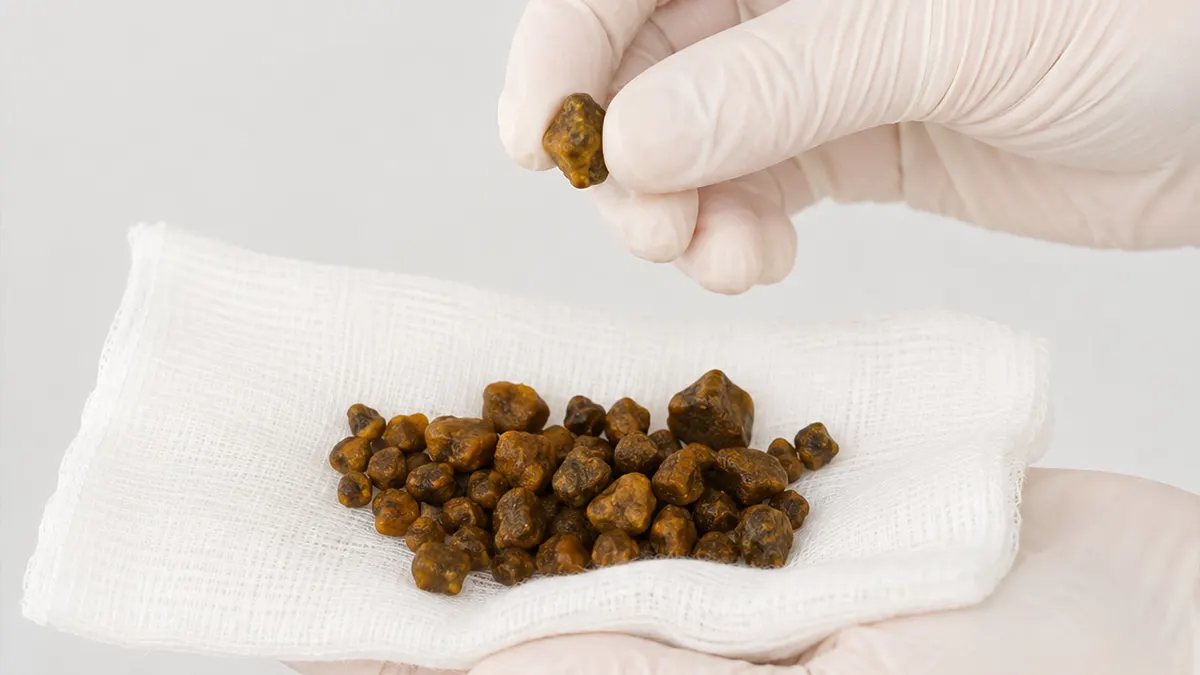
Gallstone size does not decide whether you need surgery. Symptoms do. Size tells you which risk you carry. Stones under 5 mm can slip into the bile duct and trigger pancreatitis. Stones over 3 cm carry a higher gallbladder cancer risk. Both are reasons to get properly assessed.
Quick Navigation
Almost every scan report gives you a measurement, so it is natural to treat that number as a verdict. Most people assume the logic is simple: small stone, minor problem, large stone, serious problem, and somewhere in between is the point where surgery starts.
Gallstones do not work that way. The size on your report is genuinely useful information, but it answers a different question than the one most people are asking.
Why Everyone Asks About the Number
The assumption is reasonable. For several conditions, size really does determine treatment, so it feels like it should here too. With gallstones, the measurement tells you which complication you are more likely to run into, not whether you are heading for an operation.
What Your Scan Report Is Actually Telling You
The risk from gallstones is not a straight line from small to large. It is closer to a curve with problems at both ends.
Small stones, under 5 mm
These are the ones most likely to move. A stone small enough to leave the gallbladder can travel into the bile duct, and that is where the more serious complications happen: blockage of the duct, jaundice, infection of the bile system, and inflammation of the pancreas.
This is the part that surprises people. A cluster of tiny stones or gravel can be a greater practical concern than one large stone that has sat still for a decade.
Medium stones, 5 mm to 10 mm
Large enough that they usually stay in the gallbladder, small enough that they can still lodge in the gallbladder's exit. That is what produces the classic attack: severe pain in the upper right abdomen that builds over an hour or two, often after a rich meal, sometimes spreading to the right shoulder blade.
Large stones, over 10 mm
These tend to stay put. They are less likely to migrate and cause duct problems, but they can press on the gallbladder wall and cause repeated inflammation.
Above roughly 3 cm, size becomes relevant for a different reason. Larger stones are associated with a higher risk of gallbladder cancer, and that association is one of the factors surgeons weigh when advising removal even in someone who has no symptoms at all.
Size and What It Means
| Stone Size | What It Makes More Likely | Why It Matters |
|---|---|---|
| Under 5 mm | Migration into the bile duct | Blockage, jaundice, bile duct infection, gallstone pancreatitis |
| 5 mm to 10 mm | Blocking the gallbladder outlet | Biliary colic, repeated painful attacks, inflammation |
| 10 mm to 30 mm | Staying in place, chronic irritation | Recurrent inflammation, thickened gallbladder wall |
| Over 30 mm | Long-standing pressure on the wall | Association with higher gallbladder cancer risk |
This table describes risk, not a treatment plan. Your surgeon will not read your measurement and reach for a corresponding procedure.
So What Decides Surgery?
Symptoms, mainly. The clearest question is whether the stones are causing you trouble. Removal is usually recommended when:
- You have had one or more genuine gallstone attacks, meaning severe upper right pain lasting hours
- You have had complications such as inflammation of the gallbladder, a blocked bile duct, or pancreatitis
- Attacks are recurring and affecting how you live and eat
- There are specific features on the scan, such as a very large stone, a calcified gallbladder wall or polyps, which raise the longer-term risk
Stones found by accident that have never caused a symptom are often simply monitored, regardless of whether they measure 4 mm or 14 mm. Conversely, a single small stone that has already caused one severe attack is far more likely to lead to surgery than a silent large one, because an attack tends to predict more attacks.
Where Size Genuinely Does Stage Treatment
It is worth knowing why the assumption exists, because for a different organ it is completely correct.
With kidney stones, size really does drive the plan: under 5 mm most pass on their own with fluids and pain relief, 5 mm to 10 mm sits in a middle band where medication may help, over 10 mm rarely passes without a procedure, and over 20 mm usually means a percutaneous approach. There the measurement maps onto the treatment pathway almost directly.
Gallstones do not behave that way because the gallbladder is a storage sac, not a drainage tube. Nothing needs to pass through it. That single anatomical difference is why the same question gets two completely different answers.
Symptoms Worth Acting On
Whatever your stone measures, these are the signals that matter:
- Severe pain in the upper right abdomen that builds and lasts more than an hour
- Pain spreading to the back or the right shoulder blade
- Nausea or vomiting, especially after fatty or fried food
- Fever or chills alongside the pain
- Yellowing of the skin or the whites of the eyes
- Pale stools or unusually dark urine
Same-Day Assessment
Fever, jaundice, pale stools or dark urine alongside gallstone pain suggest the bile duct may be involved. These need assessment the same day rather than a wait-and-see approach.
Pain that reaches around toward the upper back with persistent vomiting can point to inflammation of the pancreas, which is treated as an emergency. If your pain sits higher or lower than expected, our guide to right-sided abdominal pain covers what else produces pain in the same area.
Who Develops Gallstones
Risk goes up if you are female, over forty, carrying extra weight, or have a family history. Rapid weight loss, pregnancy, diabetes and certain medications also raise the chances. Knowing your own risk profile is more useful than watching a measurement, because it tells you how closely to pay attention to symptoms.
Getting a Clear Answer
An ultrasound scan is the standard way to find gallstones and measure them. It is quick, painless and involves no radiation. If the bile duct is a concern, further imaging or blood tests such as a liver function test may follow.
If you have been given a stone size and are not sure what it means for you, that is a reasonable thing to have explained properly. Gallbladder stone assessment and surgery at Unittas Hospital covers both the watchful approach and keyhole removal, and the first step is simply working out which one you actually need.
Frequently Asked Questions
Is a 5 mm gallstone dangerous?
It is small enough to move, which puts it in the group more likely to enter the bile duct. That does not mean it will. If it has never caused symptoms, it may be monitored rather than removed.
What is the largest a gallstone can get?
They range from grains of sand to several centimetres. Stones above 3 cm are uncommon and are the ones where size itself becomes a factor in advising removal.
Can a small gallstone cause more trouble than a large one?
Yes, and this is the most useful thing to understand. Small stones travel, and complications from a stone stuck in the bile duct are generally more serious than a stone sitting quietly in the gallbladder.
If my stone is not causing symptoms, do I need surgery?
Usually not. Silent gallstones are commonly monitored. Certain scan findings, including a very large stone or a calcified gallbladder wall, may change that advice.
Do gallstones grow over time?
Some do, slowly. Others stay the same size for years. Growth alone is not usually the reason for surgery.
Can gallstones be dissolved with medication?
Only in a narrow set of cases involving small cholesterol stones and a working gallbladder, and treatment takes many months with a high rate of recurrence. It is not an option for most people.
Will changing my diet get rid of existing stones?
No. A sensible diet can reduce how often you get attacks and may help prevent new stones forming, but it does not dissolve the ones already there.
How many stones is too many?
The count matters less than whether they cause symptoms. Multiple small stones are worth noting because more stones mean more opportunities for one to migrate.
What is gallstone pancreatitis?
It happens when a stone blocks the shared duct near the pancreas, causing sudden severe upper abdominal pain that spreads to the back, usually with vomiting. It is a medical emergency.
Can I live normally without a gallbladder?
Yes. The liver continues to produce bile, and most people notice little difference after recovery, though some prefer smaller and less fatty meals in the first weeks.
Does the type of stone change the risk?
Cholesterol stones are the most common. Pigment stones are more often linked to blood or liver conditions. Type influences why they formed more than what size means for you.
Can gallstones return after gallbladder removal?
Not in the gallbladder, since it is gone. Stones can rarely form in the bile ducts afterwards, which is uncommon and usually linked to other conditions.
Been given a stone size?
Our gastroenterology and surgical team will tell you whether it needs treating or watching.