


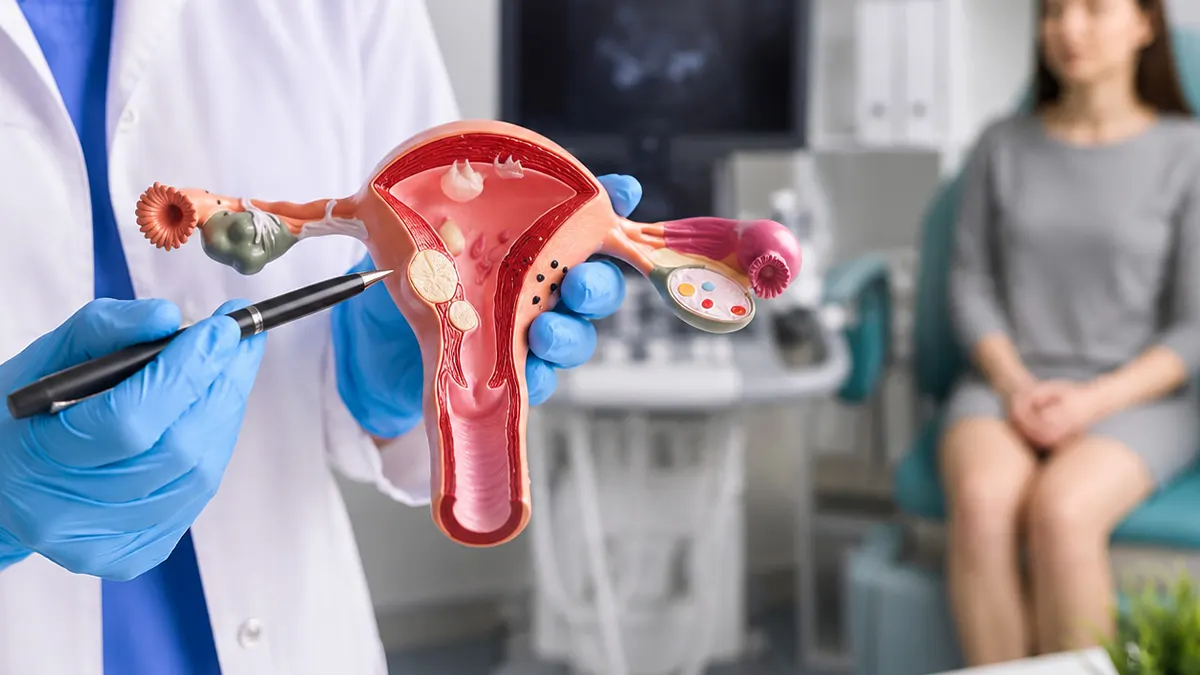
Subserosal fibroids grow on the outer wall of the uterus, so they press on nearby organs rather than affecting the uterine lining. That means bloating, back ache and bladder pressure are typical, while heavy periods usually are not. Treatment depends on your symptoms and plans, not on the diagnosis alone.
Quick Navigation
If a scan has told you that you have a subserosal fibroid, the most useful thing to understand is where it sits. Fibroids are classified by position, and position is what determines the symptoms you get.
Subserosal means it grows on the outside of the uterus. That single fact explains most of what follows, including why the symptom everyone associates with fibroids is often absent.
What a Subserosal Fibroid Is
Fibroids are non-cancerous growths of muscle and fibrous tissue in the wall of the uterus. A subserosal fibroid develops on the outer surface, just beneath the serosa, which is the thin membrane covering the uterus.
Some sit directly against the uterine wall. Others grow outward on a stalk, in which case they are described as pedunculated. They range from a few millimetres to large enough to be felt through the abdomen.
Why They Cause Pressure Rather Than Heavy Bleeding
Heavy and prolonged periods are the symptom most people associate with fibroids. That association comes mainly from a different type.
Fibroids that grow inside the uterine cavity, called submucosal, sit against the lining that sheds each month. They distort that lining and increase the surface area that bleeds, which is why they are strongly linked to heavy periods.
A subserosal fibroid is on the opposite side of the uterine wall. It does not touch the lining, so it usually has little effect on menstrual bleeding. What it does instead is take up space, and that produces an entirely different symptom pattern based on which neighbouring organ it presses against.
The Practical Takeaway
If you have been diagnosed with a subserosal fibroid and your periods are unusually heavy, it is worth asking whether something else is contributing. Heavy bleeding is not the expected pattern for this type, and assuming the fibroid is the cause can delay finding the real one.
Symptoms to Watch For
Many subserosal fibroids cause nothing at all and are found incidentally during a scan for something else. When they do cause symptoms, the symptoms follow the pressure.
- Fullness or heaviness low in the abdomen, sometimes with visible bloating.
- Lower back ache or pelvic discomfort, particularly if the fibroid grows backward.
- Needing to pass urine frequently, or difficulty emptying the bladder fully, if it presses forward onto the bladder.
- Constipation or a change in bowel habit, if it presses backward onto the bowel.
- Pain during sex, depending on its position.
- A dull ache that comes and goes rather than sharp constant pain.
Larger fibroids are more likely to produce noticeable effects, simply because they displace more. Sudden severe pain is not typical and can indicate that a pedunculated fibroid has twisted on its stalk, which needs prompt assessment. Our guide to right-sided and pelvic pain in women covers what else produces pain in the same area.
How the Types Differ
| Type | Where It Grows | Typical Symptoms | Effect on Periods |
|---|---|---|---|
| Subserosal | On the outer surface of the uterus | Pressure, bloating, back ache, bladder or bowel symptoms | Usually little or none |
| Intramural | Within the muscular wall itself | Pelvic pain, pressure, enlargement of the uterus | Can increase bleeding |
| Submucosal | Bulging into the uterine cavity | Heavy or prolonged bleeding, anaemia, fertility difficulty | Strongly linked to heavy periods |
| Pedunculated | On a stalk, inside or outside | Intermittent pain, sudden severe pain if it twists | Depends on where the stalk attaches |
This is why two people can both be told they have a fibroid and have completely different experiences. Common gynaecological problems covers where fibroids sit alongside conditions such as endometriosis and PCOS.
Why They Develop
The exact trigger is not fully understood, but oestrogen and progesterone clearly drive their growth, which is why fibroids typically appear during the reproductive years and often shrink after menopause.
- Being in your thirties or forties, when hormone levels are at their most active
- A family history of fibroids
- Carrying extra weight, which raises circulating oestrogen
- High blood pressure
- A diet low in fruit and vegetables
Pregnancy can cause existing fibroids to grow because of the hormonal surge, and many shrink again afterwards.
How They Are Found
Most are picked up during a routine pelvic examination or an ultrasound scan. An MRI is sometimes used for larger or more complex cases, where the exact size, number and position matter for planning.
Because subserosal fibroids sit on the outside, they are usually straightforward to see and measure on a scan.
Treatment Options
Treatment is decided by your symptoms, the size and position of the fibroid, and whether you are planning a pregnancy. It is not decided by the diagnosis alone, and many women need no treatment at all beyond periodic monitoring.
- Watchful waiting. Appropriate for fibroids that are small, stable and not causing symptoms.
- Medication. Can manage pain or temporarily reduce fibroid size, usually as a bridge rather than a permanent solution.
- Procedures that cut the blood supply, shrinking the fibroid without removing it.
- Surgical removal, known as myomectomy, which removes the fibroid and leaves the uterus in place. This is the usual choice when fertility is a consideration.
- Hysterectomy, reserved for cases where other options are unsuitable and future pregnancy is not planned.
If you are weighing your options, fibroid treatment at Unittas Hospital starts with working out whether you need an intervention at all.
Living With Them
Most women with subserosal fibroids lead entirely normal lives, and most fibroids shrink significantly once hormone levels drop after menopause. Regular monitoring and a clear plan for what would prompt a review are usually all that is needed.
Frequently Asked Questions
Can subserosal fibroids affect fertility?
They usually do not, because they sit outside the uterine cavity. Very large ones can distort the shape of the uterus or press on the fallopian tubes, which is when fertility may be affected.
Do they always grow over time?
No. Some enlarge slowly, some stay stable for years, and many shrink after menopause when oestrogen levels fall.
Is there any link to cancer?
Subserosal fibroids are almost always benign. A cancerous change is very rare, and rapid growth after menopause is the main feature that prompts closer assessment.
Why are my periods still heavy if this type does not cause that?
It is worth investigating. You may also have a fibroid of another type, or an unrelated cause such as adenomyosis or a hormonal issue, which is a useful question to raise with your doctor.
Can exercise make the symptoms worse?
Gentle activity is usually helpful. High-impact exercise can occasionally increase pressure or discomfort with a large fibroid.
How quickly can one grow?
Growth rates vary widely. Some enlarge noticeably over months, others remain unchanged for years, which is why monitoring intervals are individual.
Are they more common after pregnancy?
They can grow during pregnancy because of hormonal changes, and many shrink again afterwards.
Will a fibroid cause weight gain?
Not directly. A large fibroid can make the abdomen look and feel fuller, which is often mistaken for weight gain.
Can diet influence fibroid growth?
A diet rich in fruit, vegetables and whole grains supports overall hormonal balance and is linked to lower fibroid risk, but it does not shrink existing fibroids.
Is the pain constant?
Usually not. It tends to be intermittent and related to the fibroid's size and which organ it is pressing on. Constant severe pain is not typical and should be assessed.
Do they disappear after menopause?
Many shrink substantially once oestrogen falls, and symptoms often ease considerably.
Can I have a normal pregnancy with one?
Yes, most women do. Monitoring during pregnancy helps manage the small number of cases where a fibroid grows enough to cause problems.
How large does it need to be before treatment?
There is no size threshold on its own. Treatment is guided by symptoms, so a small fibroid causing real problems may be treated while a larger silent one is monitored.
Diagnosed with a fibroid?
Our gynaecology team will tell you whether it needs treating or simply monitoring.