


Quick Navigation
- NICU vs PICU at a glance: the key differences
- What is a NICU and which babies need it?
- What is a PICU and which children are admitted?
- Who decides where a child goes? Age bands and grey areas
- How do the equipment and the environment differ?
- Who looks after your child, and what can parents do?
- When does a child need emergency care right now?
- Planning ahead: high-risk pregnancy and where to deliver
- Frequently Asked Questions
A NICU (neonatal intensive care unit) cares for newborns, mostly in the first 28 days, especially premature or low birth weight babies. A PICU (paediatric intensive care unit) cares for critically ill infants, children and teenagers from about 1 month to 18 years. Both give round-the-clock intensive support, but the age group, equipment and specialist teams differ.
When a newborn or a child is seriously ill, parents suddenly hear two similar-sounding words: NICU and PICU. Both are intensive care units. Both run 24 hours a day and look after the smallest and sickest patients. The difference between NICU and PICU comes down to who they admit, what they treat and how the unit is set up.
This guide puts NICU vs PICU side by side: what each unit does, which babies need NICU care, who decides where a child goes, and what you can do as a parent during a stay.
Key Takeaways
- NICU means neonatal intensive care: for newborns, mainly in the first 28 days, especially premature and low birth weight babies.
- PICU means paediatric intensive care: for critically ill infants, children and teenagers from about 1 month to 18 years.
- The main differences are the age group, the reasons for admission, the size of the equipment and the specialists on the team.
- There is no fixed age cut-off: a baby who has been in the NICU since birth usually stays under the NICU team even after 28 days.
- Parents are part of the team in both units: ask questions, be present, and, once the baby is stable, hold your baby skin to skin.
NICU vs PICU at a glance: the key differences
The quick comparison first; the rest of the article explains each row.
| Aspect | NICU (neonatal intensive care unit) | PICU (paediatric intensive care unit) |
|---|---|---|
| Age group | Newborns, mainly the first 28 days (longer if admitted at birth) | Infants to teenagers, about 1 month to 18 years |
| Typical reasons for admission | Prematurity, low birth weight, breathing trouble, severe jaundice, infection, birth defects | Severe infection or sepsis, breathing failure, major injury or burns, uncontrolled seizures, recovery after big operations |
| Focus of care | Helping a baby finish developing outside the womb: warmth, breathing, feeding, growth | Supporting failing organs through serious illness or injury |
| Equipment | Incubators, radiant warmers, CPAP and small ventilators, phototherapy lights | Child-sized ventilators, monitors, infusion pumps and beds |
| Lead specialists | Neonatologists and neonatal nurses | Paediatric intensivists and PICU-trained nurses |
| Typical length of stay | Often weeks, especially for very premature babies | Days to weeks, depending on the illness |
| The child's role | Fully dependent on the team | Older children can say how they feel and take part in their care |
In short: the NICU helps a newborn who is not yet ready for the outside world, while the PICU rescues a child whose body was working normally until illness or injury struck.
What is a NICU and which babies need it?
NICU stands for neonatal intensive care unit: a specialised ward for newborns, above all babies born early or with health problems in the first weeks of life. A baby may be admitted for:
- Premature birth (before 37 weeks)
- Low birth weight
- Breathing difficulty soon after birth
- Jaundice that needs intensive treatment such as phototherapy
- Infection appearing in the first days of life
- Congenital conditions or birth defects that need close monitoring or surgery
Even a full-term baby can need a short NICU stay, and most go home within days. Not every NICU offers the same level of support: units are graded from basic newborn care up to complex ventilation and surgery, and in government hospitals a Level II unit is often called an SNCU (special newborn care unit), and the grade matters when you plan where to deliver. See our guide to the different levels of NICU care.
What is a PICU and which children are admitted?
PICU stands for paediatric intensive care unit. It cares for critically ill infants, children and teenagers, usually from about 1 month to 18 years. Common reasons for admission include:
- Severe infections such as pneumonia, dengue with complications, or sepsis
- Breathing failure that needs ventilator support
- Recovery after complex heart, brain or abdominal surgery
- Serious injuries from road accidents, falls or burns
- Seizures that will not stop with usual treatment, or other sudden brain and nerve problems
- Dangerous complications of long-term conditions such as asthma or diabetes
Because patients range from a 2-month-old to a 17-year-old, everything is adapted, from the size of the breathing tube to how staff explain procedures. Older children can often say what hurts and help decide their care.
Who decides where a child goes? Age bands and grey areas
Doctors decide, based on the child's age at admission and the nature of the problem. It usually follows a simple pattern:
- A baby admitted from the delivery room, or in the first 4 weeks of life, goes to the NICU.
- A baby who has been in the NICU since birth stays under the neonatal team until discharge, even past 28 days.
- An infant who has gone home and later becomes seriously ill, say with a severe chest infection at 6 weeks, is usually admitted to a PICU.
- Children and teenagers who need intensive care go to the PICU.
Not every hospital has both units; many maternity hospitals run a NICU but not a PICU. In that case the emergency team stabilises the child first, then arranges care in a hospital with a PICU. It is worth asking your hospital which units it has.
How do the equipment and the environment differ?
Inside a NICU
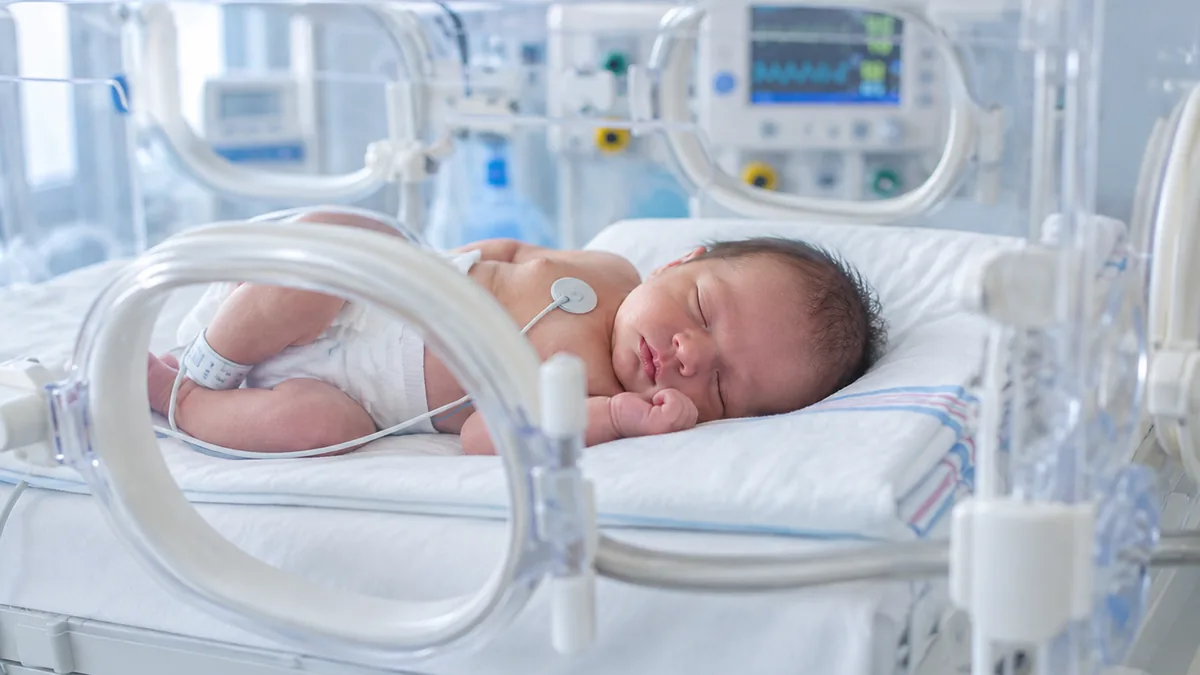
Newborns lose heat fast and their lungs may be immature, so the NICU, and premature baby care especially, is built around warmth and gentle support. Incubators and radiant warmers hold body temperature. CPAP and small ventilators help with breathing. Phototherapy lights treat jaundice. Soft sensors track heart rate, breathing and oxygen. Feeding is often through a fine tube until the baby can suck and swallow safely.
The room is quiet and dimly lit. Babies are handled as little as possible, because noise, light and handling stress a premature baby.
Inside a PICU
A PICU looks more like an adult ICU scaled for children. Beds and cots come in different sizes. Ventilators and infusion pumps are set for the child's weight, and there is more space for procedures. It is usually busier and noisier than a NICU, because the mix of conditions is wider and children are awake for more of the day.
Why the two units are kept separate
A ventilator or a drip is only safe when it is set for the patient's size. A 1 kg premature baby and a 40 kg teenager need different machines, medicine volumes and expertise.
Who looks after your child, and what can parents do?
Both units run 24 hours a day with a doctor always present and a high number of nurses per patient.
- NICU: neonatologists (paediatricians with extra training in newborn medicine), neonatal nurses, and often a lactation counsellor
- PICU: paediatric intensivists (paediatricians trained in intensive care), PICU nurses and, depending on the problem, paediatric surgeons, neurologists or cardiologists
- Both: physiotherapists, dietitians, pharmacists and counsellors for the child and the family
You are not a visitor; you are part of your child's care. Most units encourage parents to be present. Timing rules depend on the child's condition and infection control. What helps most:
- Ask for one clear update a day, and write down your questions between rounds
- In the NICU, once the baby is stable, ask about kangaroo care (holding the baby skin to skin); it steadies breathing and temperature and builds bonding
- Express breast milk if you can; even small amounts are valuable for a premature baby
- In the PICU, bring a familiar toy or blanket, and talk to your child even if they seem asleep
- Look after yourself: eat, sleep in shifts with your partner, and accept counselling if it is offered
When does a child need emergency care right now?
Most NICU admissions are decided at birth, but many PICU admissions begin with a parent noticing that a child is very unwell. Trust that instinct.
Go to emergency now if your child has any of these
- Fast, laboured or noisy breathing, grunting, or the skin between the ribs sucking in with each breath
- Blue or grey lips or tongue
- Very drowsy, floppy, hard to wake or not responding
- A seizure lasting more than 5 minutes, or a first-ever seizure
- A baby under 3 months with a temperature of 38°C or more, or feeding poorly and passing very little urine
- A serious injury, burn or suspected poisoning
Do not wait for an appointment: call an ambulance or go to the nearest emergency department.
Unittas Hospital runs a 24-hour emergency department. A seriously ill child is assessed and stabilised there first. If paediatric intensive care is needed, the team arranges transfer to a hospital with a PICU and hands over directly.
Planning ahead: high-risk pregnancy and where to deliver
If your pregnancy is high risk, for example twins, diabetes, high blood pressure or a baby known to be small, your obstetrician will usually advise delivering in a hospital with a NICU on site. That way the baby gets support in the first minutes, not after a transfer. Our guide to types of high-risk pregnancy explains which pregnancies need this planning.
At Unittas Hospital, maternity packages are backed by an on-site Level II NICU. Level II units care for moderately premature or unwell newborns and arrange transfer to a higher-level unit if a baby needs more. For children of all ages, the paediatric team handles assessment, admission and follow-up after an intensive care stay.
NICU and PICU are two doors to the same kind of care: intensive, round the clock, and built around the size and needs of the patient. Knowing which is which takes some fear out of a frightening time. For follow-up after intensive care, or simply to plan ahead, our children's hospital team is a good place to start.
Frequently Asked Questions
What is the full form of NICU and PICU?
NICU is the neonatal intensive care unit, for newborns. PICU is the paediatric intensive care unit, for infants, children and teenagers. Both are intensive care units, separated by the age and size of the patient.
Can a full-term baby still need the NICU?
Yes. Full-term babies sometimes need short-term intensive support for breathing problems, a suspected infection or severe jaundice. Most go home within a few days.
What is the age limit for NICU and PICU?
The NICU cares for newborns, mainly in the first 28 days, and the PICU takes children from about 1 month up to 18 years. A baby who has been in the NICU since birth usually stays there until discharge even if that runs past 28 days.
Can a child ever be treated in a NICU after going home?
Usually not. Once a baby has gone home and later becomes seriously ill, admission is normally to a PICU or a children's ward, because NICUs are designed and staffed for newborns.
Are parents allowed to stay with their child in the NICU or PICU?
Most modern units encourage parents to be present and involved. Timing rules vary with the child's condition and infection control, so ask the unit about its policy.
Is the PICU only for life-threatening conditions?
It cares for the most seriously ill or injured children, but that includes children recovering from major surgery who simply need close monitoring for a day or two.
How long do babies usually stay in the NICU?
Anything from a few days to several weeks or longer. Very premature babies often stay until close to the date they were originally due.
Do NICU and PICU use the same ventilators?
Both use advanced breathing support, but the machines and settings are matched to the size and lungs of the patient. A newborn ventilator and a teenager's ventilator are set up very differently.
Can parents hold their baby in the NICU?
Yes, once the baby is stable. Skin-to-skin contact, called kangaroo care, is encouraged in most NICUs because it steadies the baby and helps bonding.
When is a child ready to leave the PICU?
When vital signs are stable, intensive support such as a ventilator is no longer needed, and the child can be safely looked after on a regular children's ward.
Planning your delivery?
Our maternity packages include on-site Level II NICU support for newborns who need extra care in the first days.
Questions about newborn or child intensive care?
Talk to the paediatric and maternity teams at Unittas Hospital, Chennai. Book a consultation, or ask about the Level II NICU support that comes with our maternity packages.