


Quick Navigation
- What is erythema toxicum neonatorum?
- What does the erythema toxicum rash look like?
- Why do newborns get erythema toxicum?
- When does it appear and how long does it last?
- Does erythema toxicum need treatment?
- When should you see a paediatrician about a newborn rash?
- How is erythema toxicum diagnosed?
- Frequently Asked Questions
Erythema toxicum neonatorum is a common, harmless rash seen in up to half of full-term newborns. It starts in the first 1 to 4 days as small white or yellow bumps on blotchy red skin, spares the palms and soles, and clears without treatment within about 2 weeks. A baby with fever, blisters or poor feeding needs a doctor.
A blotchy red rash on newborn skin, dotted with tiny white or yellow spots, looks alarming on a 2-day-old baby, especially when everything about your newborn feels precious and new. In most cases it is erythema toxicum neonatorum, a very common and completely harmless newborn rash. It bothers parents far more than it bothers the baby.
This guide shows you what erythema toxicum looks like, why it happens, how long it lasts and, most importantly, the signs that mean a rash is something else and needs a paediatrician.
Key Takeaways
- Erythema toxicum neonatorum affects up to half of healthy full-term newborns and is not an infection or an allergy.
- It appears in the first 1 to 4 days as small white or yellowish bumps on blotchy red skin, spares the palms and soles, and moves around from day to day.
- It clears on its own in 5 to 14 days without creams or medicines and leaves no marks.
- Not every newborn rash is harmless: fever, spreading pustules, blisters, or a baby who is feeding poorly or unusually sleepy needs a doctor the same day.
What is erythema toxicum neonatorum?
Erythema toxicum neonatorum, often shortened to ETN or simply erythema toxicum, is a temporary skin reaction seen in up to half of healthy full-term newborns. The ETN rash is much less common in premature babies.
Despite the frightening name, there is nothing toxic about it. 'Erythema' means redness and 'neonatorum' means of the newborn. The rash is not an infection, not an allergy to milk, soap or anything the mother ate, and not a sign of a deeper problem.
The fluid inside the little bumps is not pus from an infection. The baby stays well, feeds normally and is not in pain.
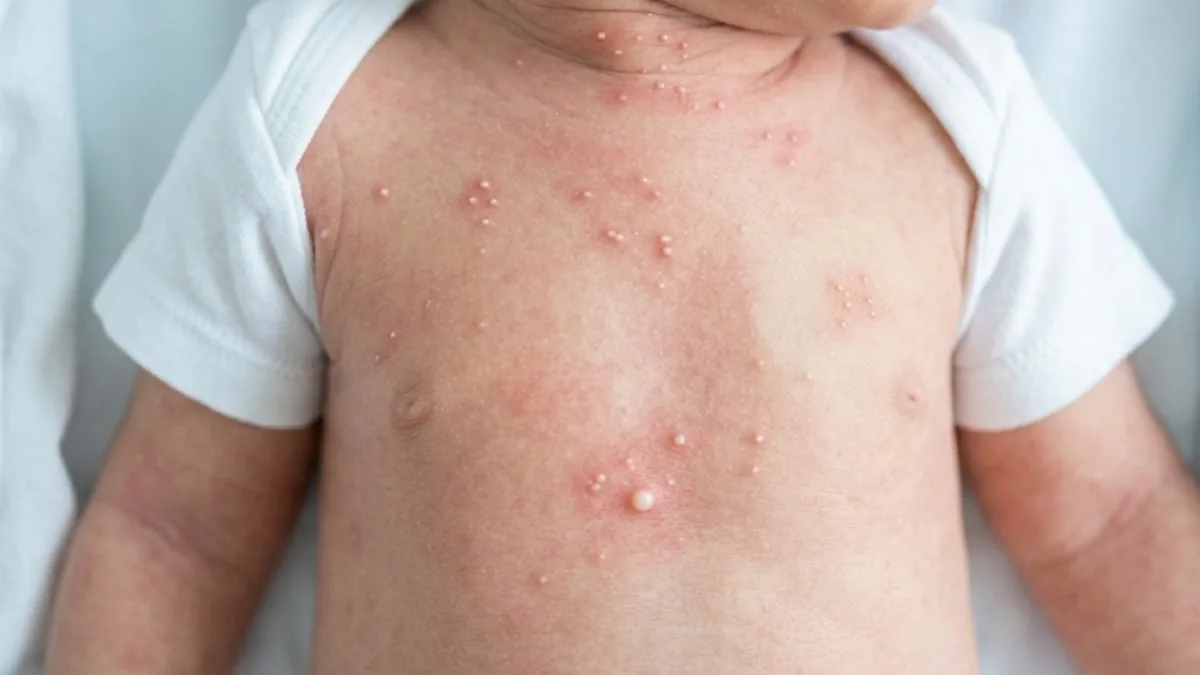
What does the erythema toxicum rash look like?
- Small white or yellowish bumps, some looking like tiny pustules
- A red, blotchy patch of skin around each bump, sometimes described as a flea-bite look
- Spots on the face, chest, back, arms and legs
- No spots on the palms of the hands or the soles of the feet
- Spots that come and go, fading in one place and appearing in another over hours or days
The baby is otherwise well: feeding, sleeping and settling normally. That combination, a dramatic-looking rash on a contented baby, is the typical picture.
How it differs from other common newborn skin changes
| Skin change | When it appears | What it looks like | What to do |
|---|---|---|---|
| Erythema toxicum | Day 1 to 4, occasionally up to 2 weeks | White or yellow bumps on red blotches; moves around; spares palms and soles | Nothing; clears in 5 to 14 days |
| Milia | At birth | Tiny firm white dots, mostly on the nose and cheeks, no redness | Nothing; clears in a few weeks |
| Neonatal acne | Around 2 to 4 weeks | Small pimples on cheeks and forehead, little or no red blotching | Gentle cleansing; clears on its own |
| Heat rash (miliaria) | Any time, in hot weather or when overwrapped | Fine red or clear bumps in skin folds, neck and covered areas | Cool the baby, light cotton clothing |
| Skin infection | Any time | Pustules that enlarge or spread, honey-coloured crusts, blisters or peeling, red spreading skin; baby may be unwell | See a paediatrician the same day |
If you are not sure which of these you are looking at, treat it as 'not sure' and get it checked. A paediatrician can usually tell at a glance.
Why do newborns get erythema toxicum?
Doctors do not know the exact cause. The most accepted idea is that the baby's developing immune system is reacting to the normal, harmless bacteria that start to settle on the skin after birth. The immaturity of the hair follicles and oil glands may also play a part.
It is more common in full-term babies than premature ones, and may be seen a little more often after vaginal birth. It is not linked to breastfeeding or formula, to the soap or oil you use, or to anything the mother did in pregnancy.
When does it appear and how long does it last?
The rash usually appears between day 1 and day 4 of life. Sometimes it shows up a little later, within the first 2 weeks, and milder cases can occasionally appear later still in the first month.
Most cases clear within 5 to 14 days. In some babies the spots keep coming and going for a few weeks before disappearing completely. There are no scars, no marks and no long-term effect on the skin.
A reassuring sign
Erythema toxicum moves. A spot that was on the chest this morning may have faded by evening while a new one appears on the thigh. Infections do not behave like this; they tend to stay put and get worse.
Does erythema toxicum need treatment?
No. It goes away on its own, and creams, antibiotics or medicated washes are not needed. Applying them can irritate delicate newborn skin and, in the case of antibiotic creams, does nothing useful.
Simple newborn skin care is all that is needed:
- Bathe with lukewarm water and a mild, fragrance-free cleanser; plain water is fine in the first weeks
- Pat the skin dry rather than rubbing, especially in the folds
- Skip heavy lotions, oils and talcum powder unless your doctor advises them
- Dress the baby in light cotton and avoid overheating, which can add a heat rash on top
- Do not squeeze, prick or scrub the spots
When should you see a paediatrician about a newborn rash?
Erythema toxicum is harmless. But 'harmless newborn rash' must never become the label for every rash, and knowing when to worry about a newborn rash matters more than knowing the name of this one. Some newborn skin infections and other conditions can look similar in the first hours and need prompt treatment. Get your baby seen the same day if you notice any of the following.
See a paediatrician the same day if
- Your baby has a fever (38°C or higher) or feels cold and mottled
- The spots are getting bigger, spreading, or filling with thick yellow pus, or are joined by blisters, peeling or honey-coloured crusts
- The skin around the spots is red, hot and swollen
- There are spots on the palms or soles
- Your baby is feeding poorly, vomiting, unusually sleepy, floppy or hard to wake
- The rash is still present and changing after 2 weeks
- A baby under 3 months with a fever needs to be seen the same day: go to the emergency department if your clinic is closed
If none of these apply and your baby is well, the rash can wait for the routine newborn check-up. If you are unsure, a quick video consultation with a paediatrician lets you show the rash from home, and the doctor can tell you whether to come in.
Babies who were premature or who needed neonatal intensive care should have any new rash checked rather than watched, because their skin and immunity are less mature.
How is erythema toxicum diagnosed?
Usually by appearance alone. A paediatrician looks at the rash in a well, feeding baby and recognises the pattern. No blood test or skin test is needed.
If the picture is unclear, for example if the baby has a fever or the spots look more like pustules, the doctor may take a simple swab or a smear from a spot to rule out infection. Treatment is decided by that result, not by the look of the rash alone.
The newborn checks that are part of postnatal care, including those in our maternity packages, are a good moment to ask about any skin change you have noticed. The child specialist team also sees newborns for rashes, feeding and weight concerns after you go home.
A blotchy rash with little white spots in the first days of life is one of the most common reasons new parents worry, and one of the most reassuring once it has a name. Gentle skin care and time are all erythema toxicum needs. Keep the red flags in mind, and when in doubt let the paediatric team take a look; that is what they are there for.
Frequently Asked Questions
Is erythema toxicum contagious?
No. It is not an infection and cannot spread to other babies or family members.
Does the rash hurt or itch the baby?
No. Babies with erythema toxicum show no sign of discomfort from the spots and feed and sleep normally.
Can premature babies get erythema toxicum?
It is much less common in premature babies and is seen mainly in full-term newborns. A rash in a premature baby should be checked by a doctor rather than assumed to be erythema toxicum.
Will the spots leave scars?
No. Once the rash clears the skin returns to normal with no marks.
Can I put cream on the rash?
It is best to avoid creams, oils or ointments unless a doctor specifically recommends them. Gentle cleansing with lukewarm water is enough.
Neonatal acne vs erythema toxicum: how can I tell them apart?
Neonatal acne usually appears later, around 2 to 4 weeks, and looks like small pimples on the cheeks and forehead without the large red blotchy background typical of erythema toxicum.
Does breastfeeding or formula affect the rash?
No. The type of feeding does not cause or worsen erythema toxicum, and there is no need to change how you feed your baby.
Can the rash come back after it disappears?
It can reappear in different areas for a short time, but it settles completely within a few weeks and does not return later in childhood.
Is erythema toxicum linked to allergies or eczema later?
There is no evidence that erythema toxicum increases the risk of eczema, allergies or other skin problems in the future.
When should I worry about a newborn rash?
Seek advice the same day if the baby has a fever, seems unwell or feeds poorly, if the spots contain pus, blister or spread, if the palms or soles are involved, or if the rash is still present and changing after 2 weeks.
Worried about a rash on your newborn?
Our paediatricians see newborns for rashes, feeding and weight concerns, in person or by video consultation.
Not sure if your baby's rash is harmless?
Book a paediatric consultation, in person or online (same-day video slots are usually available) at Unittas Hospital, Chennai, in person or online. A quick look is all it usually takes to put your mind at rest.