


Quick Navigation
- What Counts as Rectal Bleeding?
- What Does the Colour of the Blood Tell You?
- What Are the Most Common Causes of Rectal Bleeding?
- When Might Rectal Bleeding Be Something More Serious?
- How Will a Doctor Find the Cause?
- When Should You See a Doctor About Rectal Bleeding?
- How Can You Look After Your Bowel Health?
- Frequently Asked Questions
Rectal bleeding is most often due to piles or an anal fissure, especially bright red blood on the toilet paper. But blood mixed into the stool, dark blood, bleeding after 45, weight loss or a lasting change in bowel habit can signal polyps, inflammatory bowel disease or rectal cancer and needs a proctologist, often with a colonoscopy.
Seeing blood when you wipe or in the toilet bowl is frightening, and many people's first thought is cancer. The reassuring truth is that most rectal bleeding, especially in younger adults, comes from piles or a small tear called an anal fissure. The less comfortable truth is that you cannot tell the cause by looking, and some bleeding is the first sign of something that needs early treatment.
This guide covers what the colour of the blood tells you, the common causes from piles to polyps, the features that are more worrying, and when to see a proctologist.
Key Takeaways
- Bright red blood on the paper or dripping into the bowl, with itching or a lump, is most often piles; sharp pain when passing stool suggests an anal fissure.
- Blood mixed into the stool, dark or maroon blood, mucus, or bleeding with diarrhoea points higher up the bowel: polyps, inflammatory bowel disease or, less often, cancer.
- New bleeding after 45, weight loss, a change in bowel habit lasting over 3 weeks, or a family history of bowel cancer means a colonoscopy, not a piles cream.
- Black, tarry stools are a different problem (bleeding from the stomach or upper gut) and need same-day medical attention.
- Any rectal bleeding that is new, heavy or keeps returning should be examined. Do not assume it is piles until a doctor has looked.
What Counts as Rectal Bleeding?
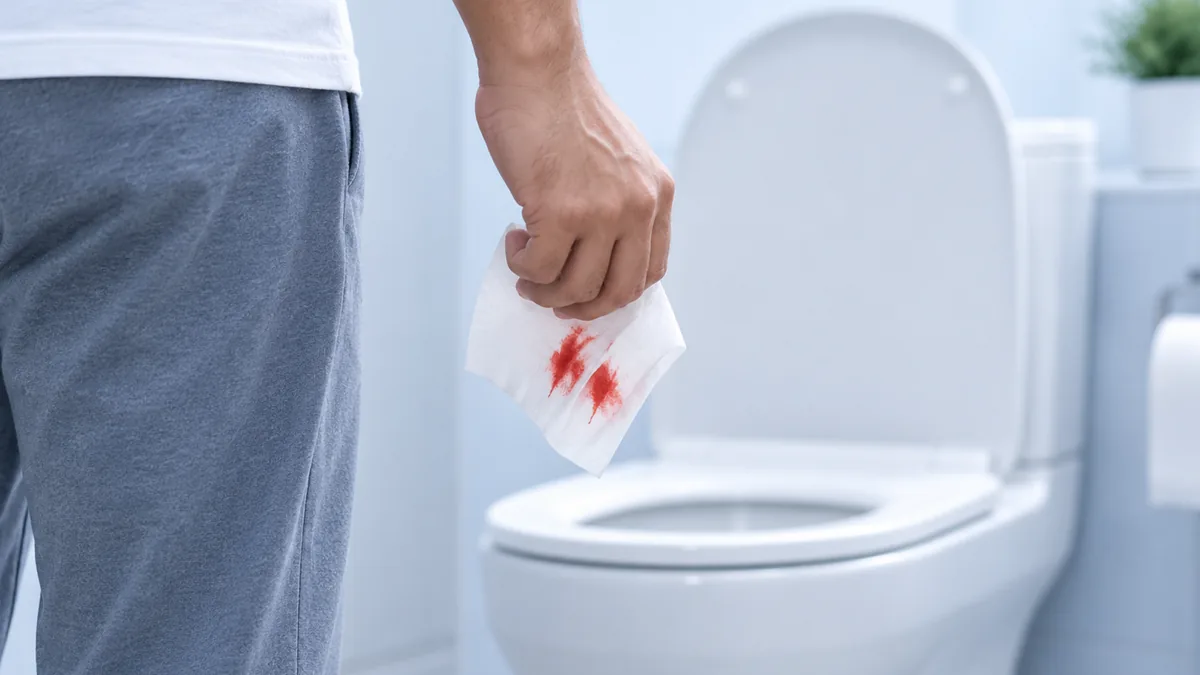
Rectal bleeding means blood from the back passage: a smear on the toilet paper, drops in the bowl, streaks on the stool, blood mixed through loose motions, or dark or black stools. Doctors call it bleeding per rectum (PR bleeding); most people call it 'blood in stool' or anal bleeding.
The amount is not a reliable guide to seriousness. A dramatic bleed from piles can be harmless, while a trace of blood mixed into the stool can be the only early clue to a polyp or tumour. Pattern, colour and your other symptoms matter more than quantity.
What Does the Colour of the Blood Tell You?
As a rule, bright red blood in stool or on the paper comes from close to the anus; blood that has travelled further turns darker.
| What you see | Where it usually comes from | Common causes |
|---|---|---|
| Bright red on the paper, dripping into the bowl, or coating the stool | The anal canal or lower rectum | Piles, anal fissure; sometimes a low rectal polyp or tumour |
| Red or maroon blood mixed through the stool, often with mucus | Higher in the rectum or the colon | Polyps, inflammatory bowel disease, diverticular disease, colorectal cancer |
| Bloody diarrhoea with cramps and urgency | Colon | Ulcerative colitis, Crohn's disease, gut infections |
| Black, sticky, tar-like stool (melaena) | Stomach or upper small intestine | Ulcers, gastritis, bleeding varices (iron tablets also darken stool) |
Colour is a clue, not a diagnosis; only a doctor can confirm the source. If your stools are black and tarry rather than red, read our guide to what black stools can mean and when to worry; that usually means bleeding higher up and needs same-day attention.
What Are the Most Common Causes of Rectal Bleeding?
Piles (haemorrhoids)
Piles are swollen blood vessels in and around the anus, made worse by straining, constipation, pregnancy and long sessions on the toilet. They typically bleed bright red and painlessly at the end of a bowel movement, sometimes with itching or a lump. Many settle with more fibre, more water and less straining; piles that keep bleeding or prolapsing have effective treatment options, including laser procedures.
Anal fissure
A fissure is a small tear in the lining of the anus, usually after a hard stool. The giveaway with anal fissure bleeding is sharp, cutting pain during and after a bowel movement, with bright red blood on the paper. Most heal with softer stools, warm sitz baths and prescribed creams. A fissure that keeps re-opening beyond 6 to 8 weeks is called chronic and may need a minor procedure; see our fissure surgery cost guide.
Polyps
Polyps are small growths on the lining of the colon or rectum. Most are harmless, but some slowly turn cancerous over years, so they are removed when found. They often cause no symptoms; when they do, it is usually a little blood mixed with the stool.
Inflammatory bowel disease
Ulcerative colitis and Crohn's disease inflame the bowel lining and cause bloody diarrhoea, mucus, cramps and urgency, often with tiredness or weight loss. They are long-term conditions managed by a gastroenterologist; our guide to the two types of inflammatory bowel disease explains how they differ from IBS.
When Might Rectal Bleeding Be Something More Serious?
Rectal cancer develops in the last part of the large bowel, just before the anus. It usually grows slowly, often from a small polyp that changes over years. Early rectal cancer symptoms are easy to put down to piles or a change in diet, which is why persistent bleeding should never be self-diagnosed.
Signs that raise concern:
- Dark blood in stool, or blood mixed through it, rather than bright red blood on the paper
- A change in bowel habit lasting more than 3 weeks: going more often, looser stools, or alternating constipation and diarrhoea
- A feeling that the bowel does not empty completely
- Stools narrower than usual, or mucus in the stool
- Discomfort or pain in the lower abdomen or back passage
- Unexplained weight loss, ongoing tiredness or anaemia
Who is more at risk? Most cases occur over 50, though rates in younger adults have been rising. Risk is higher with a diet heavy in processed or red meat and low in fibre, with being overweight or inactive, smoking and heavier drinking. A history of polyps or inflammatory bowel disease, or a strong family history of bowel cancer, also raises it. Risk factors do not mean you will get cancer, and many people diagnosed had none. They simply lower the threshold for getting checked.
If a tumour is found, treatment depends on its stage and position. Our rectal cancer treatment page outlines the pathway, and the cancer care team can explain the next steps. Found early, rectal cancer is very treatable.
How Will a Doctor Find the Cause?
The assessment is quicker and less awkward than most people fear:
- History: colour, amount, timing, pain, bowel habit, weight, family history and medicines such as iron tablets and blood thinners.
- Examination: a look at the anus and a gentle finger check of the rectum, often with a proctoscope (a short lighted tube) to see piles or a fissure.
- Colonoscopy or flexible sigmoidoscopy if the source is not obvious, you are over 45, or any red flag is present. Polyps can be removed and biopsies taken at the same time.
- Scans, if a cancer is found, to check its stage and plan treatment.
A proctologist, a specialist in the rectum and anus, treats piles, fissures and fistulas and knows when you need a colonoscopy. Bleeding that has gone on for weeks deserves a specialist's eyes, not another tube of cream.
When Should You See a Doctor About Rectal Bleeding?
Any new bleeding from the back passage deserves at least one examination. Book within a week or two if it is small, bright red and clearly linked to constipation or straining. Do not wait if any of these apply.
See a proctologist and ask about a colonoscopy if
- You are over 45 with new bleeding
- The blood is dark, maroon or mixed into the stool
- There is mucus or bloody diarrhoea
- Your bowel habit has changed for more than 3 weeks
The same applies if you have lost weight without trying, feel constantly tired or are anaemic, if a close relative has had bowel cancer or polyps, or if bleeding has continued for more than 2 weeks despite treating it as piles. For this list, 'probably piles' is not an answer. Get examined and, if advised, have the colonoscopy.
Go to an emergency department right away if you are passing a lot of blood or clots, feel faint, dizzy or breathless, have black tarry stools with weakness, or have severe abdominal pain with the bleeding. Unittas Hospital's emergency department is open 24 hours.
How Can You Look After Your Bowel Health?
Not every cause can be prevented, but everyday habits lower the risk of piles and bowel cancer:
- Eat more fibre-rich foods and vegetables, and drink enough water
- Do not strain or sit on the toilet for long stretches
- Keep a healthy weight and stay active
- Limit processed meat and alcohol, and do not smoke
- Ask about screening if you are over 45 or have a family history of bowel cancer
Organised bowel screening is not routine in India, so ask your doctor about a screening colonoscopy from around 45 to 50, or earlier with a family history, even without symptoms. It finds polyps before they turn into anything worse.
Most rectal bleeding turns out to be piles or a fissure, and both are very treatable. But most is not all, and the features that separate the two are easy to check: blood colour, age, bowel habit and weight. If any of them worries you, or the bleeding keeps coming back, get examined rather than guessing.
Frequently Asked Questions
Piles vs cancer bleeding: can you tell them apart at home?
Not reliably. Both can cause bright red bleeding, which is why the cause cannot be judged by looks alone. New or persistent bleeding should be examined, especially after 45 or with any change in bowel habit.
What colour is blood from piles?
Usually bright red, seen on the toilet paper, dripping into the bowl or coating the stool, and typically painless. Dark or maroon blood mixed with the stool suggests a source higher up.
Is blood on toilet paper always piles?
No. A fissure, a low polyp, an infection or, less commonly, a rectal tumour can all leave blood on the paper. If it happens more than once or twice, get it checked.
Can constipation cause rectal bleeding?
Yes. Straining with hard stools is the commonest reason for piles and fissures. Treating the constipation often stops the bleeding, but the source should still be confirmed.
When is rectal bleeding an emergency?
Heavy bleeding or clots, feeling faint or dizzy, black tarry stools with weakness, or severe abdominal pain with bleeding need emergency care straight away.
How fast does rectal cancer grow?
Most rectal cancers develop slowly from polyps over several years, which is why removing polyps found at colonoscopy prevents many cancers.
Can younger adults get rectal cancer?
Yes. It is more common over 50, but cases in adults under 50 have been increasing, so persistent symptoms at any age should be investigated.
Is a change in bowel habit always serious?
Not always, but a change that lasts more than 3 weeks should be discussed with a doctor, particularly alongside bleeding, weight loss or tiredness.
Will I need a colonoscopy for rectal bleeding?
Not everyone does. If you are young and the doctor finds a clear cause such as piles or a fissure, an examination may be enough. Colonoscopy is advised when the source is unclear, you are over 45, or red flags are present.
What does incomplete emptying feel like?
It is the sensation of still needing to go after opening the bowels, or of something being left behind. On its own it can be piles or constipation, but with bleeding or a change in bowel habit it needs assessment.
Bleeding that keeps coming back?
A proctologist can examine you discreetly, confirm the cause and arrange a colonoscopy only if it is really needed.
Stop guessing about the bleeding
Book a confidential consultation with a proctologist at Unittas Hospital. Most causes are simple to treat, and the serious ones are far easier to treat early.